Trust Fund Factsheet
Tools for » Bhutan UN Country Fund
In Focus

Fund Dates

Bhutan UN Country Fund - Reports

Bhutan UN Country Fund - Updates

About

Overview

Bhutan became the world’s youngest democracy following the successful elections to the country’s first democratically elected Parliament in March 2008. This major political transition requires support over the long term. Challenges remain to build a firm foundation for the smooth functioning of a democratically elected government, through further strengthening of the constitutional bodies, enhanced capacity development of local governments, expanding the role of civil society, an independent media and continued progress in the socio-economic arena. The credibility of democratic governance, central to the achievement of human development, is dependent on the success of the newly established democratic institutions and their ability to effectively address the overarching national goal of poverty eradication.

The UNDAF Action Plan for Bhutan (Common Country Programme Action Plan: cCPAP 2008-2012) was developed in response to the challenges and opportunities associated with this transition to democracy as well as the significant capacity constraints in most sectors to adequately support the country’s socio-economic development. It is the result of a highly consultative and participatory process involving the Royal Government of Bhutan, key national implementing partners, all resident and non-resident UN agencies supporting Bhutan and other international partners. The cCPAP is fully aligned with national development priorities laid out in the 10th Five-Year Plan of the Royal Government, and encompasses the activities of 15 UN agencies supporting Bhutan (UNCTAD joined the cCPAP signatories on 30 June 2009) within the five UNDAF outcome areas of support, namely: poverty reduction; health; education; good governance and environment conservation & disaster risk management, with gender and ICT as cross cutting areas for support. Click here for more information on these five thematic areas.

The objective of the UN Bhutan Country Fund (Terms of Reference) is to channel additional donors’ funding to support the un(der)funded portions of the UNDAF/cCPAP and new initiatives responding to emerging needs. This will enhance the flexibility and responsiveness of the UN system through the UNDAF/cCPAP to adapt to national priorities. The UN Bhutan Country Fund will support allocation and disbursement of donor resources and coherent resource mobilization and will contribute to realizing the UNDAF/cCPAP outcomes by strengthening the planning and coordination process, and channeling consistent and predictable funds towards the highest programme priorities.

The UN Bhutan Country Fund is administered by the UNDP Multi-Partner Trust Fund Office (MPTF Office) in accordance with its financial regulations and rules.


Assistance Strategy

Bhutan’s unique long term vision and guiding development philosophy of Gross National Happiness (GNH) is seamlessly aligned with the MDGs. The core pillars of GNH: sustainable and equitable socio-economic development, conservation of the environment, preservation and promotion of cultural heritage and good governance cover all of the MDGs. As such, just as the MDGs serve as a practical global road map for the Millennium Declaration, in Bhutan the MDGs are viewed as highly relevant development strategic framework contributing to realizing Gross National Happiness as the country’s long term development goal. This synergy between GNH and MDGs has enabled Bhutan to be one of the few countries in the region which is on track to achieving almost all of the MDGs by 2015. Thus, the UNDAF/cCPAP has been a catalyst to this realization.


Alignment Between National Priorities and UN Bhutan Areas of Support


National Priority UNDAF Outcome
1. To halve poverty by 2013 By 2012, opportunities for generation of income and employment increased in targeted poor areas. (MDG 1, 8)
2. To improve accessibility, quality and sustainability of health care delivery system By 2012, increased access and utilization of quality health services with emphasis on reproductive health, maternal and child health and nutrition, HIV/AIDS, TB, malaria and non-communicable diseases. (MDG 4,5,6)
3. To improve quality, relevance and coverage of education By 2012, access to quality education for all with gender equality and special focus on the hard-to-reach population improved. (MDG 2,3)
4. To foster good governance as a core value for development By 2012, institutional capacity and people’s participation strengthened to ensure good governance. (MD & MDG 1,3,8)
5. To enhance environmental sustainability and disaster management By 2012, national capacity for environmental sustainability and disaster management strengthened (MDG 7)

The UNDAF/cCPAP 18 month Work Plans is the programmatic planning document that will serve as the basis for funding requests and allocations. The 18-month work plan is a functional compromise to adapt to the national fiscal cycle and is in accordance with the Paris Declaration on Aid Effectiveness. These Work Plans are derived from the budgetary framework of the cCPAP.


Governance

The Government is fully involved at all levels of the UNDAF/cCPAP implementation. As reflected in the Management & Implementation Framework, the joint Government-UN Country Programme Board is responsible for the overall implementation and supervision. The Board provides supervision and guidance to the joint Theme Groups who are responsible for the formulation, monitoring and evaluating the implementation of the cCPAP through the 18 month work-plans with the implementing partners.

The Steering Committee
The Steering Committee is comprised of UN signatories to the UN Bhutan Country Fund and the Gross National Happiness (GNH) Commission, and is co-chaired by the Secretary of the GNH Commission and the UN Resident Coordinator. The Steering Committee is governed by its Terms of References. The Steering Committee will be responsible for prioritization and allocation decisions of the UN Bhutan Country Fund. The initial prioritization for allocation will be guided by recommendations from the Joint Theme Groups’ annual review process. The Steering Committee will also provide guidance on the operations and management of the Fund. Annually, it will review the joint resource mobilization strategy and subsequently implement it. The Steering Committee will ensure that the Country Programme Board is informed of the allocations, and will take into consideration the Country Programme Board’s strategic priorities.

Resident Coordinator
The overall management of the UN Bhutan Country Fund will be led and coordinated by the Resident Coordinator in consensus with the Heads of the Participating UN Organizations. In line with the overall objective of ‘Delivering as One’ in Bhutan, the Resident Coordinator will be responsible for the strategic leadership of the UN Bhutan Country Fund on the basis of the UNDAF/cCPAP. The RC will also advocate and mobilize resources for the UN Bhutan Country Fund in collaboration with Participating UN Organizations and lead a consultative process on allocations from the UN Bhutan Country Fund, and make final decisions if consensus cannot be reached, with documented process and rationale for these decisions. Whereas the implementation of the programme activities funded by the resources from the UN Bhutan Country Fund will be the responsibility of the Participating UN Organizations, the RC will hold the Heads of Participating UN Organizations accountable for their Organization’s components of the results of initiatives funded through the UN Bhutan Country Fund.

The Administrative Agent
The UNDP Multi-Partner Trust Fund Office (MPTF Office) has been appointed the Administrative Agent of the UN Bhutan Country Fund. Its responsibilities include the receipt, administration and management of contributions from Donors; disbursement of such funds to the Participating UN Organizations in accordance with the approved programmatic documents; and provision of consolidated narrative and financial reports, in accordance with the MOU, on the UN Bhutan Country Fund to donors, based on reports of the Participating UN Organizations.


Decision-Making Process

The UNDAF/cCPAP 18 month Work Plans is the programmatic planning document that will serve as the basis for funding requests and allocations. The 18-month work plan is a functional compromise to adapt to the national fiscal cycle and is in accordance with the Paris Declaration on Aid Effectiveness. These Work Plans are derived from the budgetary framework of the cCPAP.

The fund allocation will follow a two-tier process (see the Fund Allocation Process). The joint Theme Groups will submit their priorities for funding based on the updated funding gap matrix, finalized at their Annual Review meetings in November each year. These proposed priorities will be compiled and reviewed by the Office of the Resident Coordinator and the GNH Commission and submitted to the Steering Committee.

The Steering Committee will review the proposed priorities and approve the initial prioritization if required, and based on it, the Steering Committee will submit an overview of the Resource Gap matrix to the donors in December each year.

Upon receipt of the funds from donors in February, or as and when needed, the Steering Committee will make the final allocation decisions, based on the financial status of the Fund and the needs of the Government. The Steering Committee will inform the Country Programme Board of the final endorsement at the Board’s annual meeting. For decision making, at least half of the Steering Committee members should be present or provide delegated authority. Decisions will be based on a consultative process and will be documented jointly by the Office of the Resident Coordinator and the GNH Commission. (See Fund Allocation Process)

The criteria for an initial allocation of funds under the UN Bhutan Country Fund include:

  1. UNDAF/cCPAP Relevance
  2. Unfunded Gap at Outcome level
  3. Joint AWP i.e. 2 or more Participating UN Organizations implementing
  4. Implementation Capacity
  5. Comparative advantage in implementing the activities
  6. Priorities which would otherwise not be funded
  7. Activities which support core UN development priorities on the MDGs, such as gender, human rights and capacity development supplemented by priorities identified by the Steering Committee and Country Programme Board at the start of the annual programme cycle
  8. Realistic Outcome Budget

Subsequent allocations will, in addition to the above, include the following:

  1. Implementing partners and Participating UN Organizations’ absorption capacity
    Previous track record:
    (a) Results
    (b) Expenditure rate and financial Management
    (c) Reporting – timeliness and quality of reporting


Recent Documents

This tab shows only recent documents relevant at the Fund level. To see more documents at both the fund and project level go to the Document Center.

Key Figures
Funding Status
Participating Organizations' 2013 expenditure reports are not yet posted. Expected 30 April of 2014, subject to timely reporting.
Total as of
Values in US$
View as Excel Print friendly format
Funds with Administrative Agent
Deposits 2,419,000  
Interest and Investment Income (from Fund) + 3,720  
Interest (from Participating Organizations) + 5,064  
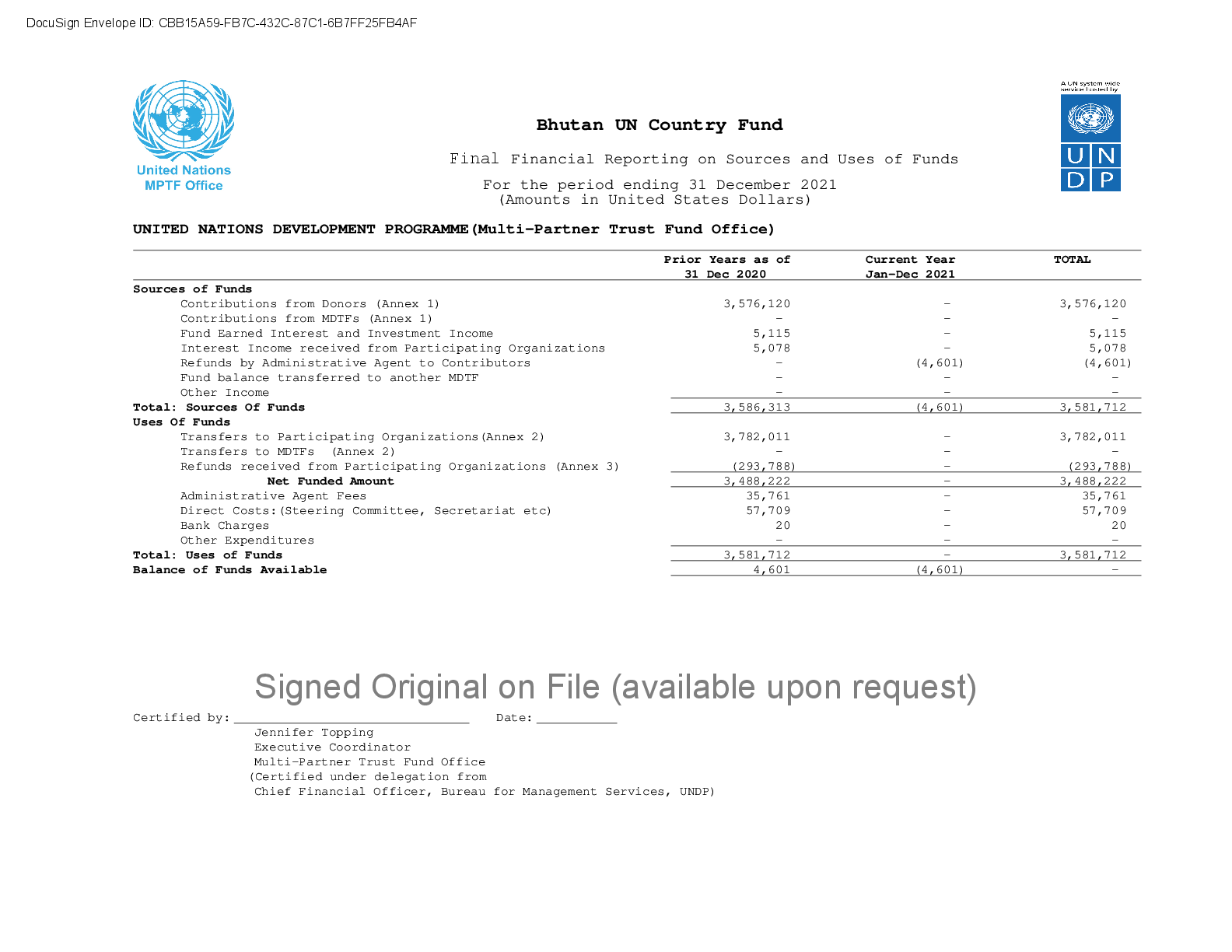
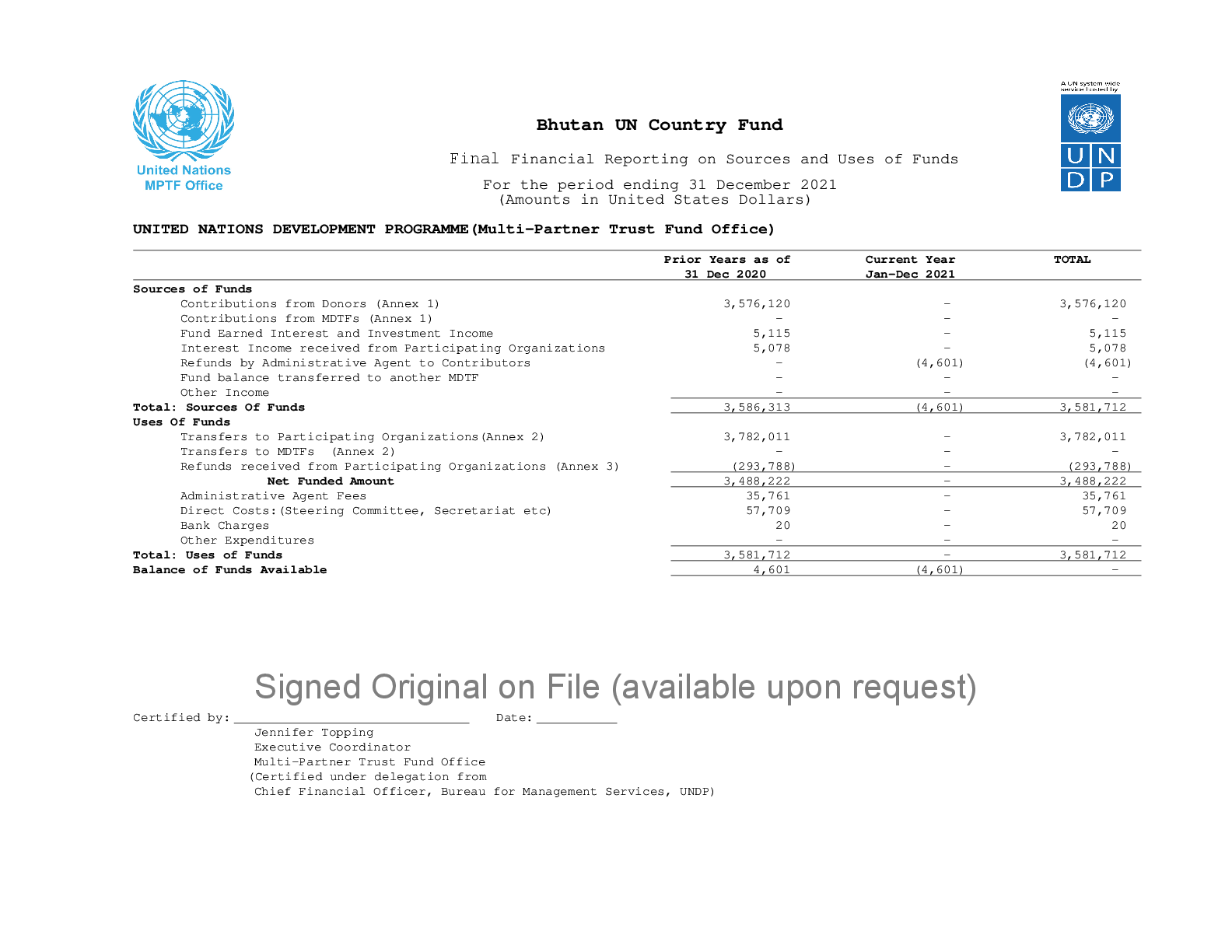
Total source of funds   2,427,784
Transferred to Participating Organizations 2,592,051  
Refunds from Participating Organizations - 257,836  
Administrative Agent Fee + 24,190  
Direct Cost + 58,120  
Bank Charges + 10  
Total use of funds   - 2,416,534
Balance with Administrative Agent   11,249
As a percentage of deposits   0.5%
Funds with Participating Organizations
Transferred to Participating Organizations 2,592,051  
Total resources   2,592,051
Participating Organizations' Expenditure 1,948,484  
Refunds from Participating Organizations + 257,836  
Total expenses   - 2,206,320
Balance with Participating Organizations   385,731
As a percentage of transfers   14.9%
Total Balance of Funds   396,980
As a percentage of deposits   16.4%
Delivery Analysis
Report by
All amounts in US$
View as Excel Print friendly format
Contributions
to All amounts in US$ Excel Print
Projects
to
Report by All amounts in US$ Excel Print
Contacts

For Policy and Programme Issues

UN Resident Coordinator Office, UN House, P.O. Box 162, Thimphu, Bhutan
Tel: (975)-2-322424; Fax: (975)-2-32265; Website: www.unct.org.bt


For Administrative Agent Issues

Multi-Partner Trust Fund Office, Bureau of Management, United Nations Development Programme; Fax: +1 212 906 6990