What is an inter-agency pooled fund?
What is an inter-agency pooled fund?
The United Nations adopted the official definition of pooled funds from the Financing and Budgeting Network in June 2015. It has since been integrated into UNSDG guidelines and UN data standards for system-wide financial reporting.
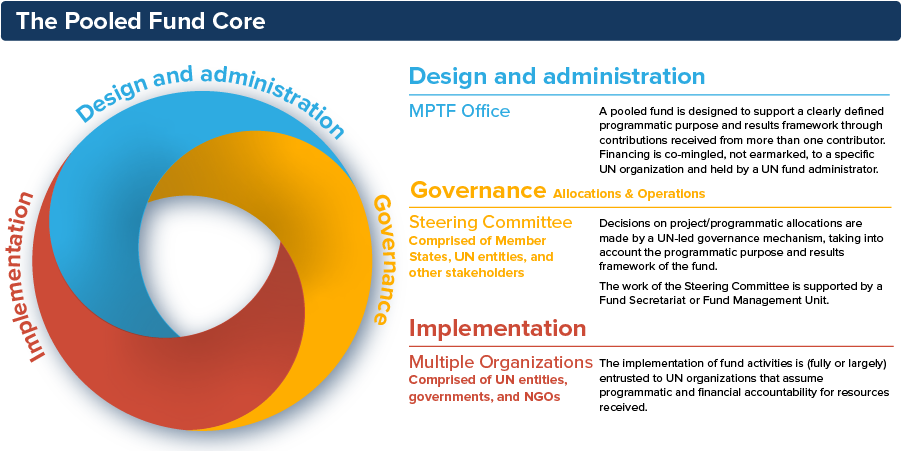
A UN inter-agency pooled fund has three distinct functional areas. The firewall and clear delimitation of different roles is key to the effective functioning of pooled funds.
Design and administration: Pooled funds support a clearly defined programmatic purpose and results framework, and rely on contributions from more than one contributor. Financing gets blended, instead of earmarked, prior to being allocated to a specific UN organization or held by a UN fund administrator.
Joint governance and/or fund operations: A UN-led governance mechanism decides on project/programmatic allocations, taking into account a fund's programmatic purpose and results framework.
Fund implementation: Implementation of fund activities is (fully or largely) entrusted to UN organizations that assume programmatic and financial accountability for resources received.
Governance and Management
Effective governance and management arrangements are crucial for attaining results. A robust and agile management architecture is central to transparent and accountable decision-making on resource allocation, monitoring, and reporting.
It also changes the nature of risks and risk-taking: In a pooled fund model, stakeholders collectively have time to put mitigation measures in place.
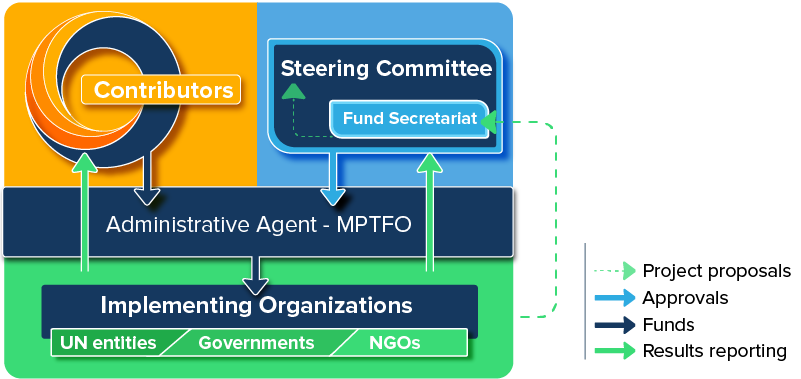
The governance and management architecture of each pooled fund administered by the MPTFO includes:
-
A Steering Committee to set the fund strategic direction, make resource allocation decisions, and monitor progress toward achieving transformative change. Typically, Steering Committee representatives come from government, central implementing partners (including the United Nations, national entities, civil society), and contributors.
-
A Secretariat ('Convening Agency' in a joint programme) provides technical and administrative support to the Steering Committee and handles day-to-day operations of the fund. Members of the Secretariat often appraise funding proposals, and take on coordination, report consolidation, and monitoring and evaluation functions.
-
Participating Organizations handle project implementation and cover UN agencies, government entities, and international financial institutions.
-
The MPTF Office, as the Administrative Agent (AA), takes on fund design and administration. Primary administrative functions include receiving and administering contributions for transfer to Participating Organizations (as per Steering Committee instructions), as well as financial and performance reporting. The Office uses standard United Nations legal agreements to establish and operationalize pooled funds to increase speed and reduce transaction costs.
The MPTFO places importance on the design of governance architecture across its portfolio of trust funds and supports smooth fund governance with secretariat support tools and services.
Our transparency-first approach and commitment to the highest transparency standards contribute to mutual accountability amongst partners. To access specifics on governance arrangements for individual pooled funds, visit the governance section.
Why Pooled Funding
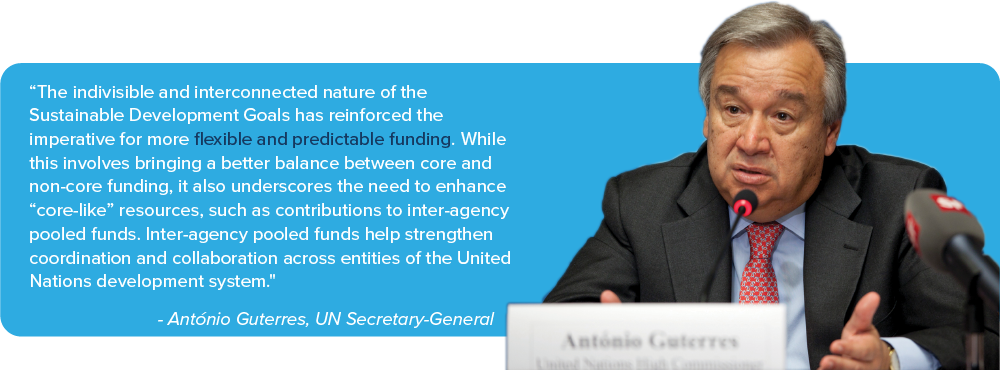
Because success requires solid, flexible, robust, transparent, and reliable financing, inter-agency pooled funds are critical for financing development and humanitarian action. Pooled funds deliver on SDG promises and fine tune how the UN fulfills its mandate.
They also bring the United Nations together by strengthening coherence, reducing fragmentation, broadening donor bases, spreading risk sharing across partners, and making it easier to tackle multi-dimensional challenges with comprehensive and innovative solutions. The advantages of pooled financing are:
Transparency and agility
A low-cost mechanism that uses UNSDG pre-cleared standard legal templates and MPTFO online platforms for transparency and management purposes.
Robust theory of change
Stakeholder-led design fully aligned with SDGs.
Center of gravity
Aligns projects and programmes around SDGs, reducing duplication and fragmentation across multiple projects.
Humanitarian-development-peace nexus
Pooled funds provide flexible financing suitable for cross-sector collaboration across the entire nexus.
Innovation
Pooled financing expands the number of partners that contribute to, and implement, funds.
Reform-booster
Fully aligned with the UN reform process to deliver better results through joint action.
New generation of climate funding
Contemporary and innovative financing instruments for climate-focused and conservation action.
Pooled finance and UN reform
Inter-agency pooled funds are a unique tool for delivering joint responses and direct resources to programmes focused on SDG achievement. Both make pooled funds an important part of the current United Nations reform process with inter-agency financing mechanisms for organizational leadership, UN Development System, and Member States to improve support to multi-partner coalitions, so national governments, civil society, and the private sector can actively work together in search of sustainable solutions.
Pooled financing is an effective instrument for improving collaboration and reducing programmatic fragmentation and, as a major tenet of the reform process, covers humanitarian, peace and security, and sustainable development. As the UN centre of expertise on pooled funding, the UN Multi-Partner Trust Fund Office works to improve the quality of investment services for all partners, across the UN broad spectrum of action.
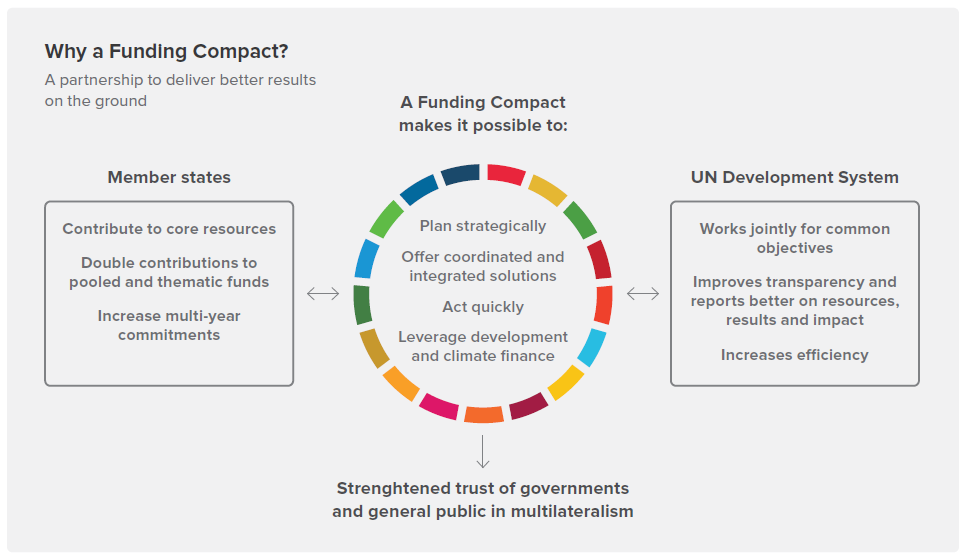

In May 2018, the UN General Assembly resolution on repositioning the UN development system led to commitments to reduce fragmentation and double inter-agency pooled funds to $3.4 billion US dollars a year by 2023. The United Nations Funding Compact (2019; updated in 2024), contains a set of pledges made by the UN and Member States to raise the quality of funding and delivery of development assistance.
The 2020 UN quadrennial comprehensive policy review (QCPR; renewed in 2024) reiterated the importance of providing flexible non-core funding, giving priority to pooled, thematic, and joint funding mechanisms. The hope is Member States and entities of the United Nations development system will contribute to the full and effective implementation of the Funding Compact and jointly make progress towards compliance with their funding compact commitments to help achieve development results on the ground.
The updated Funding Compact includes specific targets on inter-agency pooled funding, including that 30% of resources from Member States committed to development-related activities be channeled through inter-agency pooled funds.