Overview
The United Nations Development Group Human Rights Mainstreaming Mechanism (UNDG-HRM) is established to further institutionalize the mainstreaming of human rights into UN operational activities for development by further strengthening system-wide coherence, collaboration and support for UNRCs and the UNCTs on human rights mainstreaming, as well as to strengthen the coherence of UN responses to national priorities, thus ensuring strong national ownership and capacity to fulfil human rights obligations. The UNDG HRM will support strategic activities at global, regional and country level that ultimately contribute to the transformational change and/or impact at the country level.
Mainstreaming of human rights within the UN system has thus been central to a series of UN reform initiatives since 1997. In the area of development, human rights mainstreaming has progressively gained momentum under the UNDG from general policy integration and coherence at global level to strengthened UN capacity for actions at country level in support of national actions through joint programming and advocacy, which was accelerated by the Global Action 2 interagency programme (2004-2008).
Political impetus for human rights mainstreaming was significantly strengthened by the 2005 World Summit, in which world leaders reaffirmed that human rights, development and peace and security are three interlinked pillars of the UN, and gave explicit support for the integration of human rights within the UN system as well as resolving to integrate human rights into their national policies. The 2007 General Assembly resolution on Triennial Comprehensive Policy Review (TCPR) further provided the context for UN operational activities for development, by ’recognizing also that development, peace and security and human rights are interlinked and mutually reinforcing, and reaffirming that development is a central goal in itself and that it constitutes a key element of the overarching framework for the United Nations operational activities for development’.
Governing bodies of many UNDG member agencies also gave explicit support for mainstreaming and contributing to human rights within their respective mandates. Numerous resolutions of the Human Rights Council (and the former Commission on Human Rights) have called upon UN agencies to contribute to human rights and to integrate human rights into their activities.
Assistance Strategy
The overall objective of the UNDG-HRM is to further strengthen system-wide coherence, collaboration and support for UNRCs and the UNCTs on human rights mainstreaming. In contributing to the overall objective, the UNDG-HRM will focus on four primary components:
-
Promoting a coordinated and coherent UN system-wide approach towards the integration of human rights principles and international standards into UN operational activities for development;
- Providing coherent support for Resident Coordinators and UN Country Teams in mainstreaming human rights;
- Developing a coherent UN-system wide approach, through cooperation and collaboration among UN agencies, to providing support towards strengthening national human rights protection systems at the request of governments; and
- Contributing to the integration of human rights issues in the overall UNDG advocacy on development agenda and global issues.
Governance
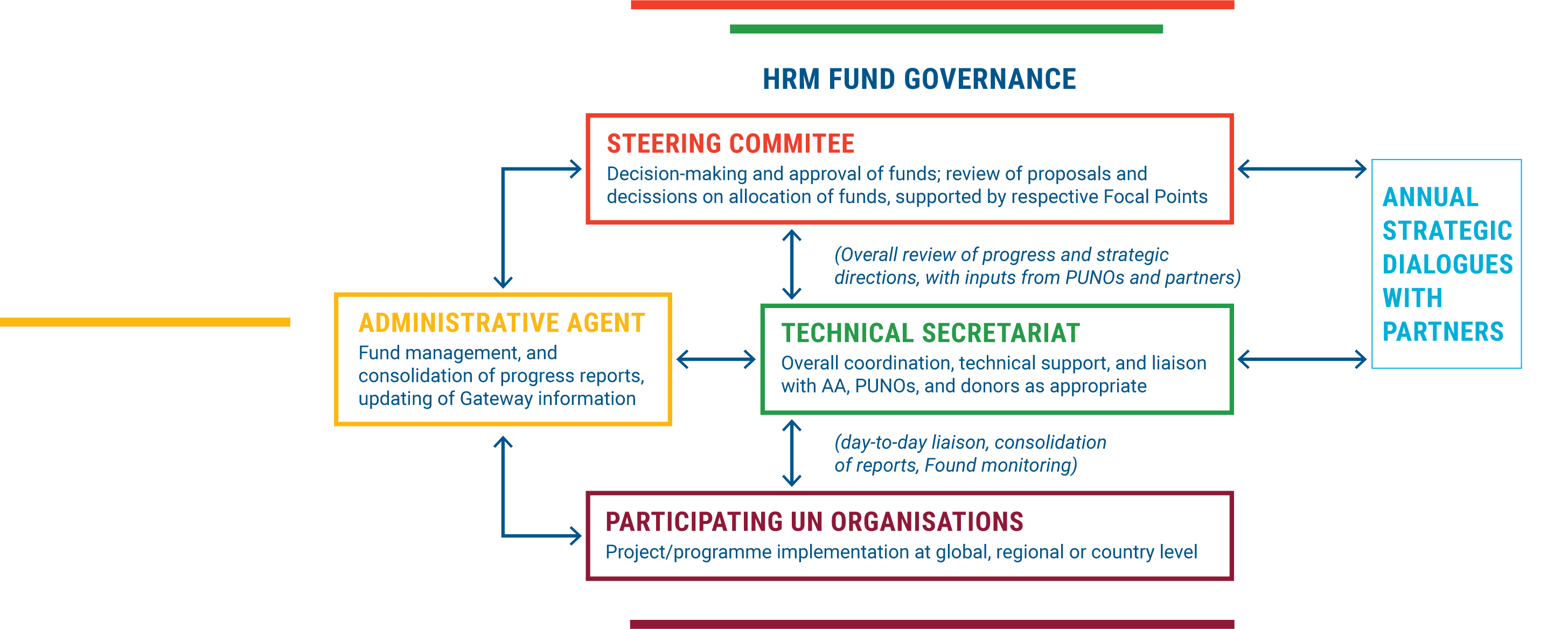
Steering Committee
The UNDG-HRM is chaired by the Deputy High Commissioner for Human Rights/OHCHR and with annually rotating Vice-Chair from participating agencies. The overall membership is at senior, decision-making level, and the members constitute the Steering Committee and provide overall leadership, set the strategic direction and approve allocations. The Administrative Agent will be an ex-officio member of the Steering Committee. The Steering Committee will task the UNDG-HRM Focal Points Group (FPG) from each of the member entities to meet regularly to prepare resource allocation recommendations for the approval by the Steering Committee.
UN Resident Coordinator
One of the main objectives of the UNDG-HRM is to support UN Resident Coordinators in their strategic leadership of the UNCTs in mainstreaming human rights at country level and relationships with national authorities. When activities are implemented at country level at the request of UNCTs, the UN Resident Coordinators will provide ongoing oversight to the programmes at the national level, ensuring the Participating UN Organizations are meeting their obligations. The UN Resident Coordinators are entrusted with supporting the overall programme design, ongoing programmatic oversight of the UNDG-HRM activities and UN coordination.
The UN Resident Coordinator at the country level also facilitates monitoring and evaluation of UNDG-HRM activities at the country level in conformity with UN standards, joint programming documents and related MoUs. On receipt of consolidated country level reports, the Resident Coordinator will provide an overall assessment of the programme’s progress and results within the scope of its role.
Focal Point Group
The role of the Focal Point Group is to review proposals submitted by Participating UN Organizations and recommend the allocation of UNDG-HRM’s funds. A separate Terms of Reference, covering key responsibilities and working methods, will be developed shortly.
Technical Secretariat
The UN Development Operations Coordination Office (DOCO), in its capacity as the UNDG secretariat, will host the UNDG-HRM, with substantive support provided by OHCHR as its lead (Chair) agency, with other agencies leading on specific components/tasks. In addition, DOCO will provide advice on UNDG policies and guidelines, and ensure institutional linkages with other UNDG Working Groups. DOCO will also be responsible for coordination of support to and communication with RCs/UNCTs and RDTs on behalf of the UNDG-HRM. For this purpose, appropriate technical capacities will be established in DOCO.
Administrative Agent
The UNDP Multi-Partner Trust Fund Office (MPTF Office) has been appointed the Administrative Agent (AA) of the UNDG HRM. The AA's functions include receipt, administration and management of contributions from Donors; disbursement of such funds to the Participating UN Organizations in accordance with the approved Annual Work Plans/Programmatic Documents; provision of consolidated narrative and financial reports, in accordance with the MOU based on reports of the Participating UN Organizations.
Participating UN Organizations
UN Organizations that participate in MPTFs or Joint Programmes are required to sign a standard Memorandum of Understanding (MOU) with the Administrative Agent (AA), and are referred to as "Participating UN Organizations". Each Participating UN Organization operates under its own financial regulations, rules and policies and assumes full financial and programmatic accountability for the funds disbursed to it by the AA and for the implementation of the project, and provides financial and narrative progress reports to the AA on its activities, as described in the MOU. Similarly, each Participating UN Organization will recover its indirect costs for implementing projects as agreed and specified in the MOU signed with the AA.
Decision Making
Participating UN Organization(s) may receive funding from the UNDG-HRM MPTF to implement programmes and activities that embody the objectives of the “Delivering as One on Human Rights: UNDG Human Rights Mainstreaming Mechanism” in accordance with the relevant interagency workplan. There are four components of activities in the workplan and the proposal(s) should contribute to one or more of the four pillars the following four broad categories:
Country level: Promoting coherent policy support and guidance to Resident Coordinators and UNCT agency leadership on human rights; enhancing learning opportunities for RCs and UNCT agency leadership on human rights; strengthening the RC Office capacity on human rights; supporting the integration of human rights into national development policies and strategies; and supporting the strengthening of national capacity on human rights.
Regional level: Strengthening capacity and collaboration at regional level, including support to RDTs.
UN system level: Strengthening system-wide coherence in policies and practices across UNDG, based on human rights standards and principles; and enhancing HRBA support to UN country teams, with particular focus on UNDAF roll-outs and Delivering as One pilots.
Advocacy and Knowledge Building: Strategic positioning of human rights in the context of UN operational activities for development; and enhancing UN system-wide knowledge codification and sharing.