Governance
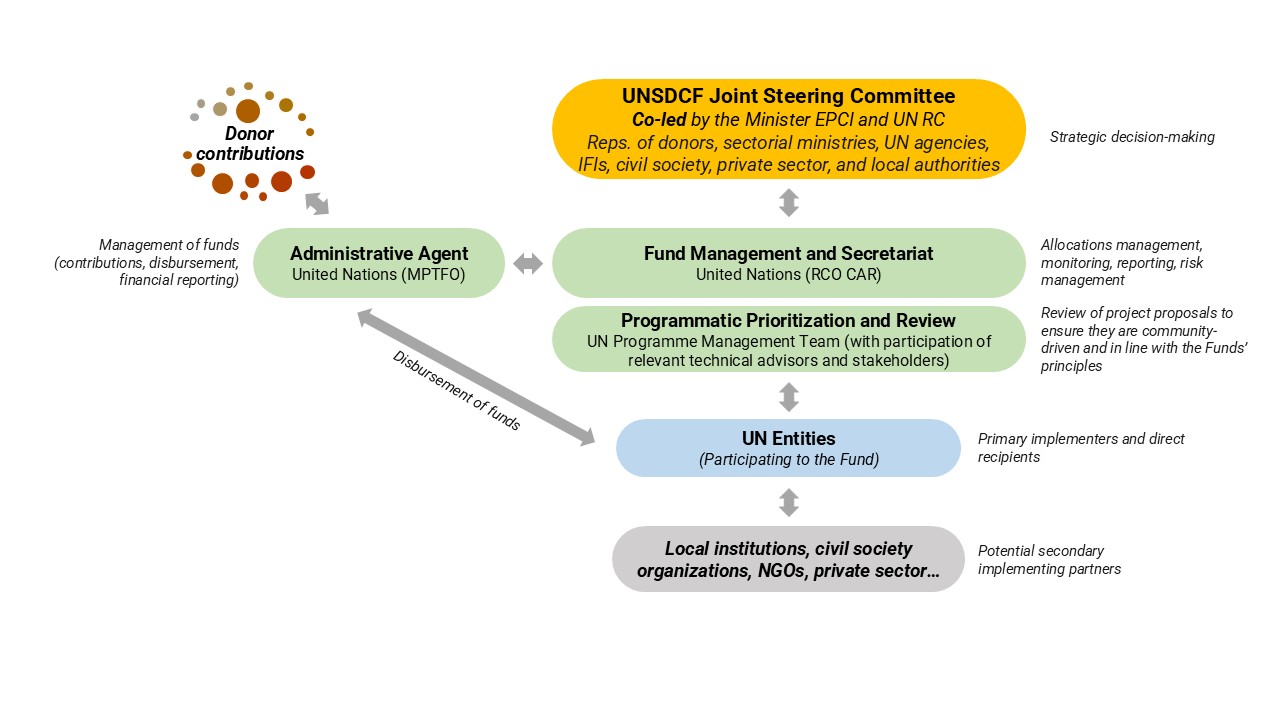
The Emai Fund uses existing UNSDCF coordination mechanisms, avoiding parallel governance structures and reinforcing national ownership and UN system coherence.
Joint Steering Committee
The Fund is governed by the UNSDCF Joint Steering Committee, co-chaired by the United Nations Resident Coordinator and the Minister of Economy, Planning and International Cooperation. The Committee also includes representatives of the UN Programme Management Team, Government, international financial institutions, donors, civil society, and the private sector.
Fund Secretariat
The Secretariat is housed within the UN Resident Coordinator's Office and is led by a Fund Manager under the supervision of the Resident Coordinator. It manages the Fund's day-to-day operations, organizes calls for proposals, coordinates proposal reviews, monitors implementation and risks, consolidates reporting, supports resource mobilization, and ensures transparency and communication.
Technical Committee
The UN Programme Management Team (PMT) serves as the Technical Committee. It reviews project proposals for technical quality, strategic alignment, complementarity with other initiatives, and compliance with the Fund's guiding principles before making recommendations to the Steering Committee. Conflict-of-interest safeguards require proposing agencies to recuse themselves from reviewing their own submissions.
Administrative Agent
The UN Multi-Partner Trust Fund Office (MPTFO) acts as the Administrative Agent under the pass-through management modality. It receives donor contributions, administers the Fund, disburses resources following Steering Committee decisions, consolidates financial reporting, and provides financial transparency through its standard fund management systems.
Participating UN Organizations
UN agencies, funds, and programmes that have signed a Memorandum of Understanding with the Administrative Agent are eligible to receive funding. They are fully responsible for the programmatic and financial implementation of approved projects in accordance with their own regulations and may partner with government institutions, civil society organizations, community-based organizations, and private sector actors to deliver results.








 > $55M
  $55M - $25M
 $25M - $5M
 < $5M
< $5M