Image


Groundbreaking impact experiments carried out by the European Centre for Medium-Range Weather Forecasts (ECMWF), commissioned by the World Meteorological Organization (WMO) provide compelling new evidence: investing in basic weather and climate observations in under-resourced countries significantly improves the accuracy of weather forecasts.
“Without data, there is no forecast. The results of the ECMWF impact experiments provide the strongest scientific evidence to date that SOFF investments to close the blind spots in the global observing system dramatically improve forecast accuracy, both locally and globally,” said Celeste Saulo, Secretary-General of the World Meteorological Organization.
SOFF is a United Nations Fund that supports countries with grant-based finance and technical assistance to close the largest weather and climate data gaps, particularly Least Developed Countries (LDCs) and Small Island Developing States (SIDS). Through SOFF support these countries will be able to generate and internationally exchange observations in line with the Global Basic Observing Network (GBON) of WMO.
Why better weather observations matter
Accurate weather forecasts save lives, protect economies, and enhance resilience to climate change. Forecasts are essential across all sectors: enabling farmers to protect crops, utilities to balance energy supply and demand, businesses to manage logistics, governments to prepare for disasters, and communities to safeguard lives and livelihoods. Yet many regions remain “blind spots” in the global observation system.
SOFF is closing these gaps by funding new and improved weather stations in countries with the largest gaps. ECMWF’s impact experiments provide a robust scientific basis for targeted SOFF investments, quantifying improvements in forecast accuracy both at the local and global level. These experiments represent the strongest evidence to date that targeted investments in GBON infrastructure in under-observed regions drive major gains in forecast accuracy.
Key findings from ECMWF impact experiments
More data means better forecasts: Forecast accuracy improves as more surface and upper-air observations are added.
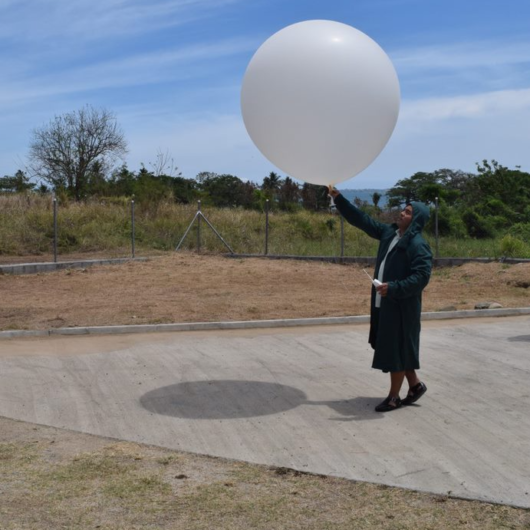
ECMWF designed eight SOFF investment scenarios simulating the impact of adding new surface, upper-air, and marine observations in countries with major observational gaps, including regions in Africa and the Pacific. Using data assimilation techniques, these simulated observations were fed into ECMWF’s operational model. The results showed that the more observations included in the simulation, the greater the reduction in forecast uncertainty, particularly over land.
“These experiments show how better observations in some of the world’s most vulnerable countries not only improve local early warning systems but also enhance the performance of global weather and climate models,” said Florian Pappenberger, Director of Forecasts and Deputy Director-General at ECMWF.
Why expand SOFF investments
The results make a strong case for expanding SOFF’s support. The experiments confirm:
The SOFF Steering Committee has recognized the ECMWF study as the most robust scientific demonstration to date of the local and global benefits of closing the weather and climate data gap. The Committee has also requested a proposal to assess the contribution of SOFF-supported GBON data to artificial intelligence-based forecasting.
SOFF is enabling countries to generate essential weather and climate observations, strengthening resilience, supporting early warning systems for all, and improving global forecast accuracy.
A summary of ECMWF’s impact experiments for SOFF is available here.
Originally published at un-soff.org