Image
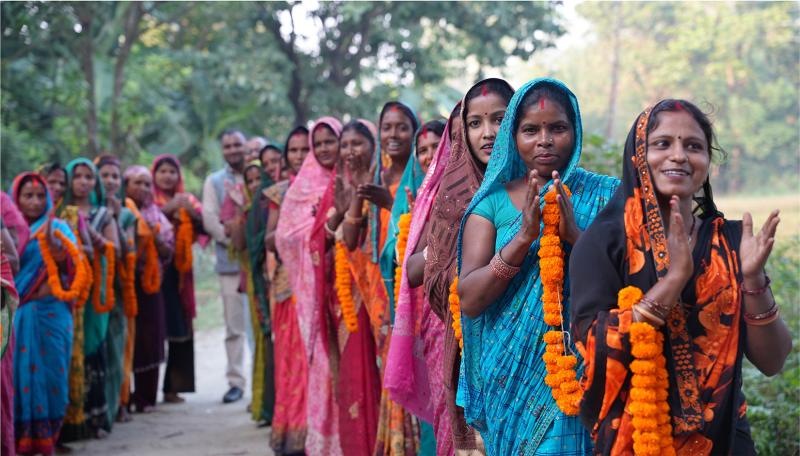

For this Practitioner’s Corner, we invited Alesia Rakuts, Knowledge Management and Communications Specialist of Economic Empowerment of Rural Women (JP RWEE), to share her insights about the initiative, its role in the socioeconomic empowerment of rural women, and the benefits derived from recent tweaks made to the Programme’s communications structure.
What is JP RWEE?
The Joint Programme on Rural Women’s Economic Empowerment (JP RWEE) is one of the UN system’s flagship joint initiatives. It brings together the Food and Agriculture Organization of the United Nations (FAO), the International Fund for Agricultural Development IFAD), the United Nations Entity for Gender Equality and the Empowerment of Women (UN Women), and the World Food Programme (WFP) and local partners under a single governance, results and financing framework.
This joint approach allows partners to support the same rural women through sequenced and complementary interventions, while working closely with national and local partners toward the overarching goal of securing rural women’s livelihoods, rights and resilience in the context of sustainable development, Agenda 2030 and the Sustainable Development Goals (SDGs).
Phase I of the JP RWEE was implemented from 2014 to 2021 in Ethiopia, Guatemala, Liberia, Kyrgyzstan, Nepal, Niger and Rwanda.
In 2026, the JP RWEE is approaching the end of Phase II (2022-2027), operating in Nepal, Niger, Rwanda, Tanzania, Tunisia, and the Pacific Islands (Fiji, Kiribati, Solomon Islands, and Tonga).
The programme is supported through contributions from Ireland, Norway, Switzerland and Sweden, with pooled funding managed by the UN Multi-Partner Trust Fund Office.
How do you ensure that all programme actors speak in one voice across such different contexts?
It’s not an easy task.
The realities of rural women in Niger are very different from those in Tunisia or the Pacific Islands. Every country has its own context, priorities and partners. At the same time, everyone is working towards the same goal: empowering rural women and creating lasting change. Speaking in one voice does not happen automatically. It requires deliberate systems, clear responsibilities and regular dialogue. This way, we created Communications Standard Operating Procedures (SOPs) that served as a roadmap to tackle part of the problem. With the SOPs everyone knew what they had to do and how, what remained is establishing the actual process.
When joining the programme team, one prominent observation one can make is how jointness is at the basis of everything we do. To connect all the dots and create a systems that feeds itself, good and regular conversation is essential.
Every month, we meet with country teams to share updates, exchange ideas and discuss opportunities. Every two months teams join ‘Knowledge Cafés’ to learn directly from one another by sharing practical experiences and lessons from the field. Every quarter, the Communications Working Group brings colleagues from across agencies and countries together to align priorities and solve common challenges.
Those conversations don’t stop when the meetings end. Stories become quarterly newsletters we share with wide network of partners, big and small operational wins become Monthly Updates we send to the programme actors, good practices become factsheets, and lessons learned in one country can inspire solutions in another.
As JP RWEE contributes to global conversations, including the 2026 International Year of the Woman Farmer, this way of working helps the programme communicate with clarity while celebrating the diversity of the women and communities it serves.
How does communication reflect the spirit of partnership, and how does the pooled fund model support that?
JP RWEE has a very powerful symbol: a piggy bank. At first glance, it represents rural women’s economic empowerment—the ability to save, invest and build a more secure future. But it also tells the story of the partnership itself. Every UN agency, government institution, local organisation and community member contributes something valuable. Like coins dropped into a piggy bank, each contribution may seem small on its own, but together they create something far more valuable.
In the same way, communication and knowledge management make sure that every story, lesson and innovation becomes part of something bigger—a shared programme, a stronger partnership and a collective impact that no single organisation could achieve alone.