> $55M
$55M - $25M
$25M - $5M
< $5M
Aligned with the national UNSDCF, Tanzania SDG Fund stakeholders address socioeconomic development challenges through the windows of human rights and gender equality, social resilience, leaving no one behind, socioeconomic and environmental sustainability, and institutional accountability.
Status: Active
Latest reports:
Fund established:
The work of the Tanzania SDG Fund is possible thanks to the efforts of . These resources are pooled and channelled to participating organizations to promote joint action and multi-stakeholder partnerships, making a difference on the ground.
Driven by the 2030 Agenda and United Nations Sustainable Development Cooperation Framework (UNSDCF), the Tanzania SDG Fund was established to contribute to accelerating SDG achievement in the run up to 2030. Although the country has made marked socioeconomic progress in the last two decades, multidimensional poverty threatens to roll back gains made.
Programme interventions are closely aligned with the new UNSDCF and 2030 Agenda (people, prosperity, planet and enabling environment) and meant to install longstanding and transformative change in four Fund outcome areas:
These areas correspond to those in the UNSCDF, as well as priority themes within each branch of Fund outcome activities. A window for cross-cutting issues is part of the Fund architecture, so partners can address complex issues in an integrated, whole-of-system manner.
Strategic action
Fund stakeholders apply the UNSCDF guiding principles of leaving no one behind, human rights, gender equality and empowerment of women, resilience, sustainability, and accountability into the design and roll-out of initiatives. In doing so, the Fund is built to make stronger and more sustainable contributions the overall reduction of multidimensional poverty in Tanzania.
Outcomes contribute to UNSDCF achievement in the four strategic, as well as realization of the 2030 Agenda. Stakeholders work on catering to the most vulnerable, launching and upgrading tailored gender transformative, inclusive and integrated basic education, health, nutrition, WASH and protection services. With regards to prosperity, partners to improve resource access for people working in micro-, small and medium-sized enterprises and small-scale agriculture, which can be used to increase business productivity and personal incomes.
Linked to the above is the application of inclusive and gender-responsive natural resource management programmes that improve the lives of all people in Tanzania—but particularly the most vulnerable—in terms of climate change resilience, DRR and an increase in efficient renewable energy. Similarly, increased local participation is encouraged in government systems and institutions for greater promotion of peace and justice in inclusive, accountable and gender responsive ways.
Steering Committee
Members of the Committee guide the strategic direction of the Fund and provide high-level oversight of UNSDCF implementation. They review and endorse administrative procedures, functions and operational guidelines, provide oversight on initiatives, approve Fund requirements concerning programme/project management and implementation modalities, and provide guidance on resource mobilization.
United Nations Resident Coordinator
As co-chair of the Steering Committee, the Resident Coordinator provides governance and strategic oversight of the Fund in coordination members of the Joint Steering Committee. The Resident Coordinator ensures the Fund is aligned with UNSDCF and national development needs/priorities and the 2030 Agenda, and mobilizes resources, strengthens partnerships in coordination with the United Nations country team, and supervises the Secretariat.
Secretariat
The Secretariat supports the Steering Committee, Resident Coordinator, and partners in programme coordination, programming cycle management, monitoring, and provision of technical, operational, and administrative support. Responsibilities include reviewing and formulating Fund proposals, ensuring Fund projects have a gender marker, consolidating narrative reports, monitoring Fund performance and operational risks, and developing the Fund communication and resource mobilization strategies.
Programme Coordination Group
Members of the group coordinate cross-cutting initiatives under that specific window. They identify projects and planning streams based on proposals received, coordinate initiative implementation, and facilitate regular discussions with donors to maintain a high-level of donor engagement. The Programme Coordination Group also takes on communication and reporting functions to improve visibility of the fund and report on results.
Participating Organizations
Participating United Nations Organizations develop project and programme proposals, and report on implementation and financial processes and outcomes. Each Participating Organization assumes full programmatic and financial accountability for funds disbursed to it by the Administrative Agent.
Administrative Agent
Recipient Organizations receive funds through the Administrative Agent, the MPTF Office. The Administrative Agent is responsible for the receipt, administration and management of contributions from donors, disbursement of funds to Recipient Organizations, and consolidation and dissemination of progress reports to donors.

The work of is possible thanks to the efforts of contributors. Since together they have contributed . In the annual contributions amounted to .
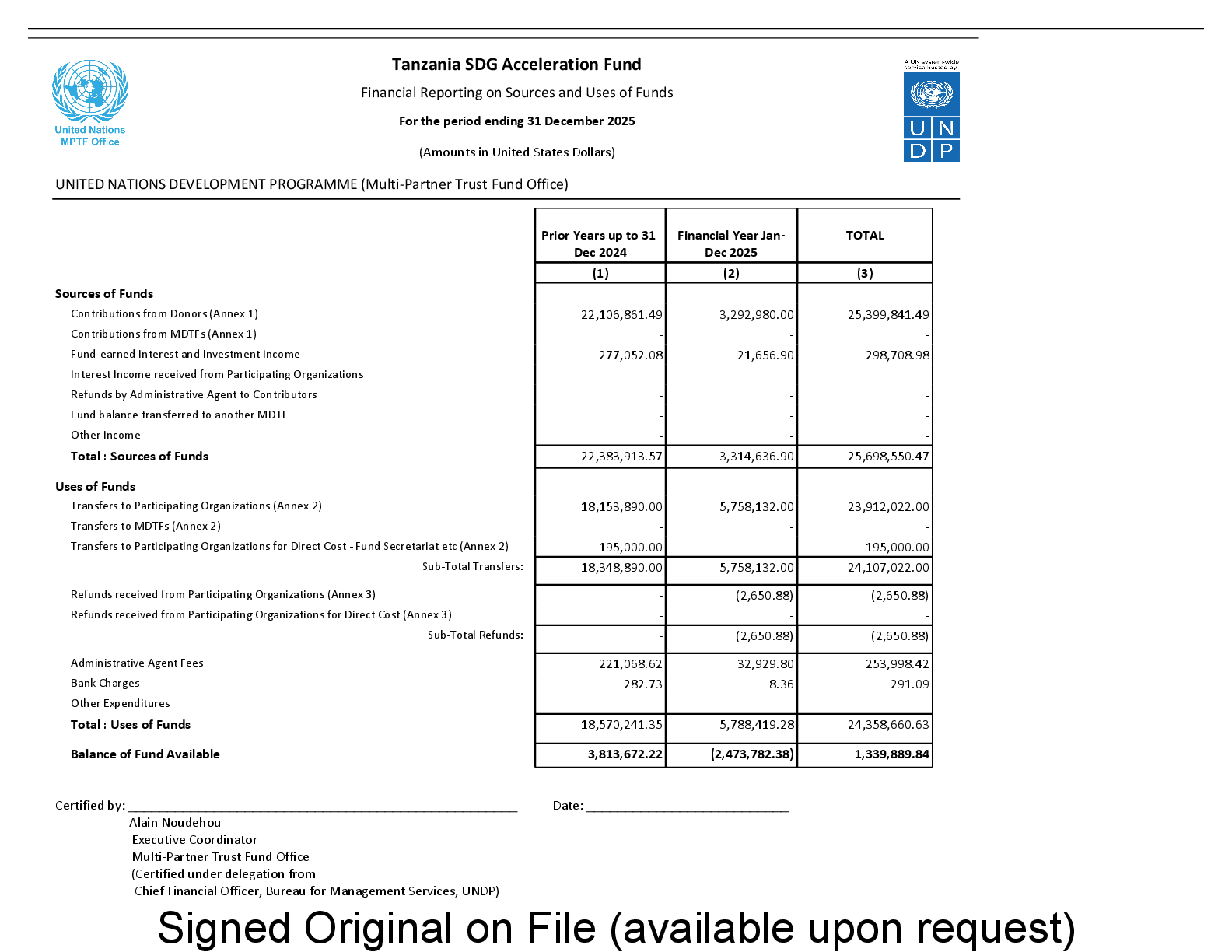
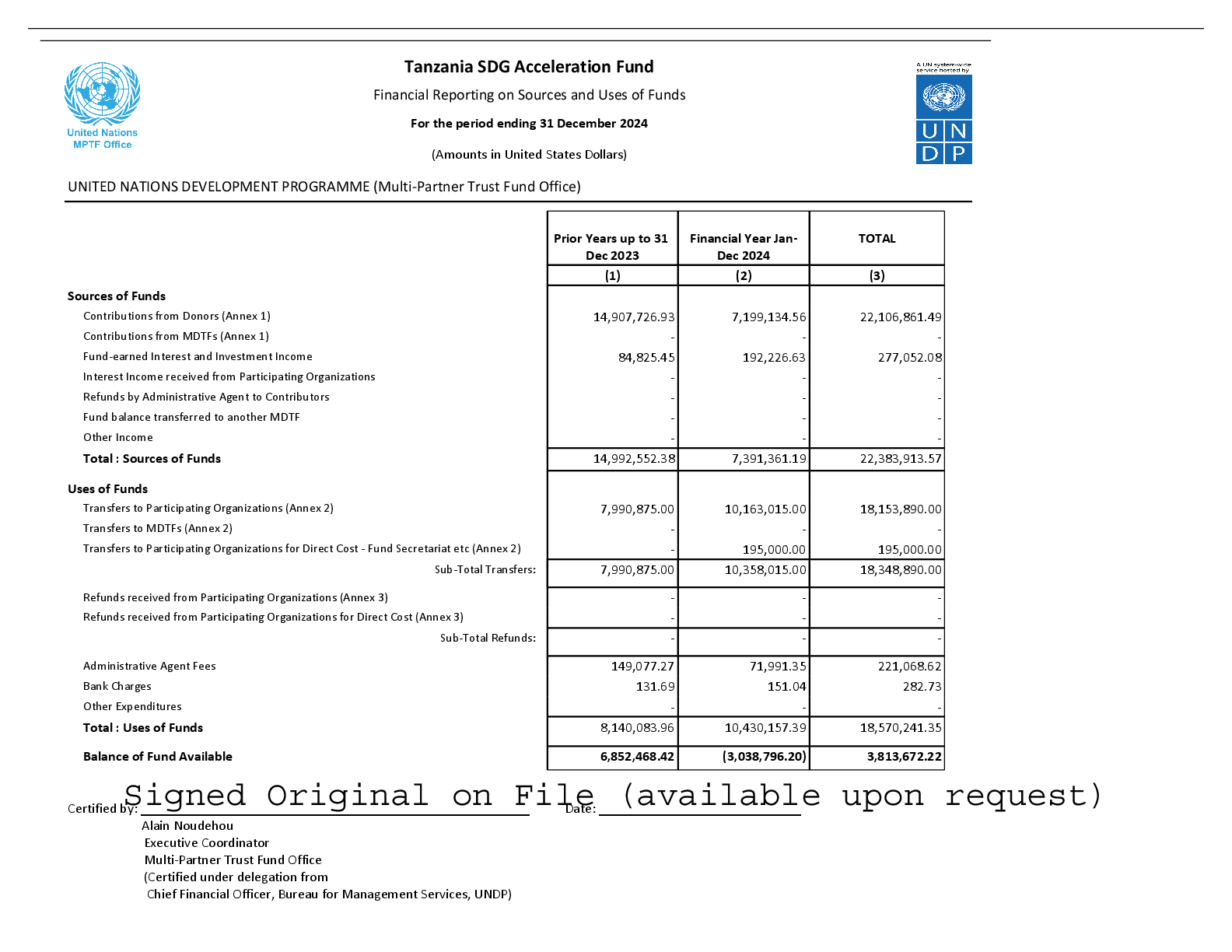
| Funds with Administrative Agent | |
|---|---|
| Contributions from Donors | |
| Contributions from MDTFs | |
| -Sub-total contributions | |
| Interest and Investment Income (from fund) | |
| Interest (from Participating Organizations) | |
| Other Income | |
| Fund balance transferred to another MDTF | |
| Refunds by Administrative Agent to Contributors | |
| Total source of funds | |
| Transferred to Participating Organizations | |
| Transfers to MDTFs | |
| Transfers to Participating Organizations for Direct Cost - Fund Secretariat etc | |
| -Sub-total transfers | |
| Refunds from Participating Organizations | |
| Refunds received from Participating Organizations for Direct Cost | |
| -Sub-total refunds | |
| Administrative Agent Fee | |
| Bank Charges | |
| Other | |
| Total use of funds | |
|
|
|
|
|
| Funds with Participating Organizations | |
|---|---|
| Transfers to Participation Organizations | |
| Total resources | |
| Participating Organizations' Expenditure | |
| Refunds from Participating Organizations | |
| Total expenses | |
|
|
|
|
|
| Total Balance of Funds | |
| As a percentage of deposits |
Tanzania SDG Fund is currently supporting count_projects ongoing projectscount_globalInterregional and count_countries country-specific. This table shows the most recently approved ongoing projects.
All project financial information can be found in the Financials section, including delivery analysis by organization, theme and project; project financial status by country and by theme.
Tanzania SDG Fund
Contributions to trust funds administered by the MPTF Office are pooled with other partner resources to achieve greater impact and leverage the SDGs. This map provides a geographical breakdown of all investments.
* The designations employed and the presentation of material on this map do not imply the expression of any opinion whatsoever on the part of the Secretariat of the United Nations or UNDP concerning the legal status of any country, territory, city or area or its authorities, or concerning the delimitation of its frontiers or boundaries.
> $55M
$55M - $25M
$25M - $5M
< $5M
Budget amounts in US$
Results are achieved in four strategic areas to accelerate SDG achievement and transform the socioeconomic landscape of Tanzanian society.
Zhanara Bakauova, Partnerships and Development Finance Officer, Email: zhanara.bakauova@un.org
Mari Matsumoto, Portfolio Manager, Email: mari.matsumoto@undp.org
Lydia Nalukwago, Portfolio Associate, Email: lydia.nalukwago@undp.org
Mir Saify, Finance Associate (DA), Email: mir.saify@undp.org
Jacqueline Carbajal, Finance Associate, Email: jacqueline.carbajal@undp.org